
Theological Triple Jump
John Kitchen
All of life is to be processed biblically. As we think our way through life, we attempt, rightly, to process it theologically. As we make our way down the path of life one step at a time, we attempt to plant our feet on solid Bible truth. We aim to make each thought correspond to truth that can be identified with a chapter and a verse. We want to think the thoughts of God after him.
In this regard God’s revelation is full and sufficient (2 Tim 3:16; 2 Pet 1:3-4). All that God has told us is true. Yet God has not told us all that is true. God’s “understanding is unsearchable” (Isa 40:28, ESV). There remain matters that are not revealed to us. “The secret things belong to the LORD our God, but the things that are revealed belong to us and to our children forever, that we may do all the words of this law” (Deut 29:29). God is beyond tracing out (Rom 11:33). No amount of mental exertion will allow us to break through beyond the veil of revelation. We cannot figure out God. He is infinite. We are finite. We are at the mercy of his revelatory grace.
What God has revealed is clear. What God has not revealed remains a mystery. But we may rest assured that what is not revealed is consistent with what has been revealed. We are not, however, exactly sure just how that consistency extends out beyond what God has revealed of himself and his ways in the Scriptures. What God has revealed is breathtaking (Rom 11:33-36). What God has not revealed remains a mystery.
To this end we must be wise as we approach the limits of God’s revelation on any given subject. There may come a moment in our step-by-step process of thinking through life biblically that we reach that boundary of what God has clearly revealed. Beyond that boundary we must tread cautiously. God is rational. God has made us in his image, part of which is being rational creatures ourselves. Thus, logic is a gift from God. But the limits of our finite minds fetter this gift from its perfect fullness, at least in this life. We are welcome to telescope our thoughts logically outward from what we know clearly from the Bible. This is where the “hop, step, and a jump” of theological thought come in. We reason our way through the Scriptures, under the ministry of the Holy Spirit. But then, having come to the limits of what God clearly says, we make a logical leap – a deduction. This deduction is an analytical jump launched from solid biblical truth with a chapter and verse. Yet the deduction itself does not have such clear, firm footing. It began from the footing of clear, solid, biblically revealed truth. But having launched logically forward it now is traveling over ground that has not been as clearly revealed. This deduction makes sense to us and we may feel a sense of confidence in our conclusion, but the ground beneath our feet is less solid than the step before. In our confidence, let us not forget this.
From this we might take a second leap, logically of course. This we might call speculation. This is worthy of our biblically informed consideration. In eternity it might even prove to be true, but we don’t know this with revelatory certainty. Awareness that we are presently two steps removed from the firm footing of solid Biblical revelation is urged. It doesn’t mean the thought is untrue necessarily, but our level of confidence in that thought and particularly our level of confidence in pressing this thought upon others is diminished.
We may feel the urge to make yet another leap of logic. To do so is not wrong, and we should not feel guilty for doing so. We must, however, be clear about just what we are undertaking. We are now three logical steps removed from the solid clarity of what God has revealed in the Bible. At this point we are in the land of fancy and conjecture. We must be exceedingly cautious about such conclusions and especially about pressing these conjectures upon others as “biblical.”
God wants us to live with conviction, based upon a clear understanding of what he has clearly revealed to us in the Bible. We can and should thus live under the authority of Scripture. God invites us to think. The ability to launch into that realm whose trajectory ends in conjecture is a God-given gift, but one that comes with an appropriate warning label. In that domain any deductions are made on the footing of logic (a gift, to be sure, but flawed and fallen and not yet fully transformed, Rom 12:2), not on the authority of God’s revelation in the Scripture.
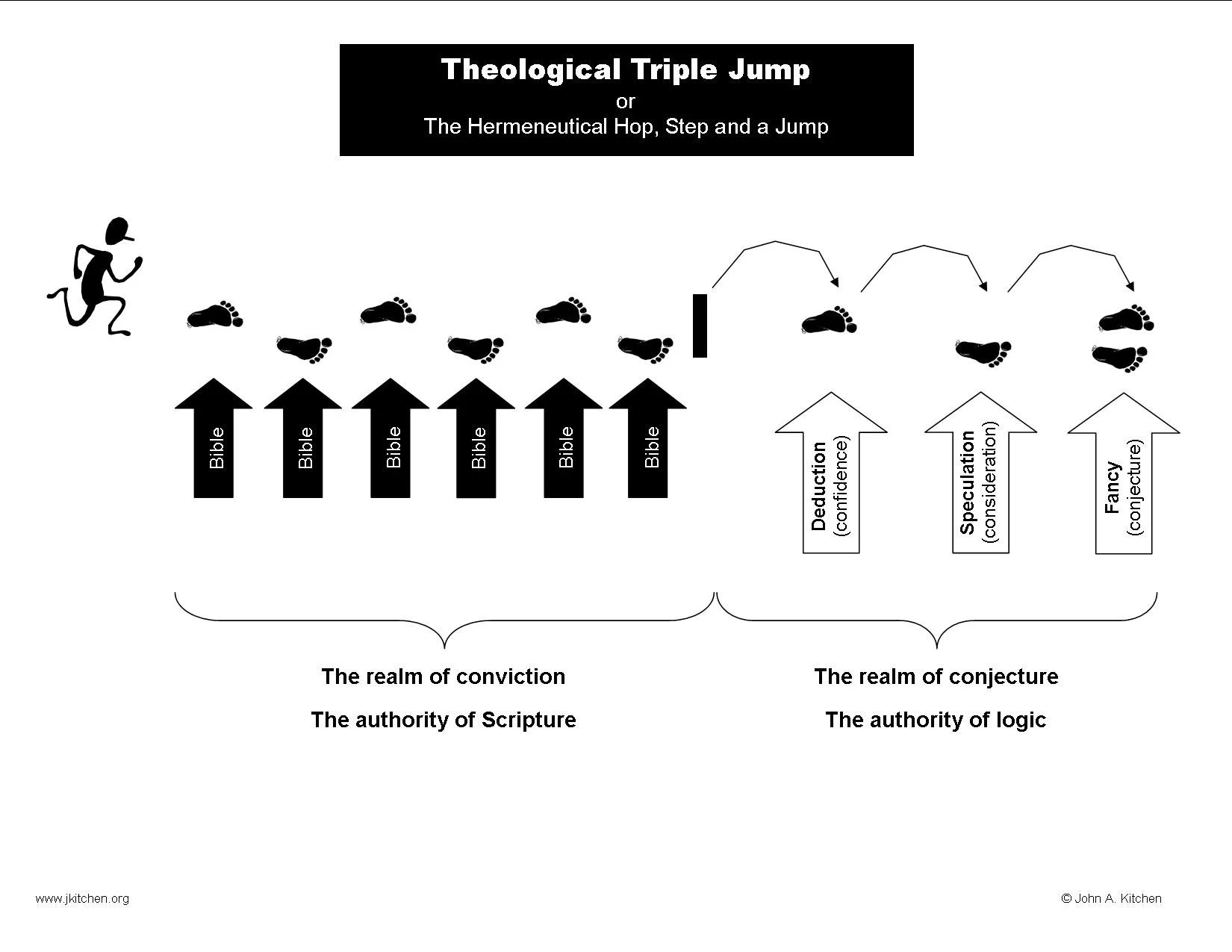
How does this theological triple jump show itself when we think through some specific issue? Let’s take the issue of suffering as a test case. This seems reasonable, for we are assured in the Scriptures that suffering is an integral part of the Christian’s experience in this life. But why do we suffer?
The Bible gives us some clear, though general, guidance about the purposes of suffering. For example, those purposes include:
Suffering as a test –to prove something (Jas 1:2-3).
Suffering as discipline – to correct something. This is always a sign of love (Heb 12:6-11).
Suffering as participation – that we might share more intimately and fully with Christ (Phil 3:8-10).
Suffering as a fact – simply existing in a fallen world means that the negative consequences of the fall affect us (Rom 8:17-23).
Suffering as refining – to purify and mature something. This relates to our sanctification (1 Pet 4:1-2; 5:10; Mal 3:2-4).
You might find in the Scriptures other purposes for suffering. My intent here is not to build a complete theology of suffering but to help us see just how the theological triple jump affects how we think of what the Scriptures say and how it applies to what we experience.
The five possible purposes of suffering are clear. They are helpful. If we had built a comprehensive theology of suffering, we could even say that they are sufficient to help us understand what we need to live faithfully and fruitfully in our suffering. Yet this does not answer all our questions. And it is worth saying that these additional questions are not wrong. They may or may not prove fruitful, but the fact we have them is not wrong. And the fact of their presence moves us, very naturally, to seek answers. But seeking these answers can move us off the solid ground of clearly revealed truth into a theological triple jump. These questions might include:
Why this form of suffering?
Why is this person suffering?
Why is this occurring at this time in this person’s life?
For instance, someone may look upon another who is suffering and declare, “This is God’s discipline!”
But does he know this? We have divine warrant to conclude this could be the purpose of this person’s suffering, but do we have Scriptural authorization to announce that it is the reason in this person’s life at this time? No. Perhaps their suffering is God’s discipline, but we do not know that with revelatory certainty.
So what do we make of this friend’s conclusion? They have taken the first step beyond the clear and certain word of God and launched into a realm that is less clear and certain. They have made a deduction. There can be some level of confidence in the possibility of this, assuming for the moment certain other factors in the sufferer’s life. But we do well to remember that confidence is not certainty.
Having concluded the person is suffering as a form of divine discipline, the next question is, why has God chosen to discipline this person? Perhaps the friend goes on to declare that God is disciplining the person because of some disobedience in their life. This is the second leap into the realm whose arc may lead to conjecture. This is speculation. Could this be the case? Yes. Is it in fact the case? Do we have certainty about this? No. The friend should have stated their case as a consideration for their friend rather than a fact (“Might there be a cause for God to bring discipline into your life?”).
The third question might be, “Why is this occurring at this particular time in this person’s life?” Perhaps the friend believes he has an answer to this as well – it is because of a failure to spend sufficient time in God’s Word each day. Does this friend know this with a sense of revelatory, Scriptural certainty? No. Even if he has evidence that his friend has indeed not been reading God’s Word each day, he does not know that this is God’s reason for allowing this suffering at this time. He has entered the land of fancy and is basing his conclusion on conjecture.
He is now three steps beyond the realm of conviction based on the authority of Scripture and is fully into the realm of conjecture based upon the footing of logic. It is not difficult to imagine the many ways these three leaps beyond the solid ground of Scriptural revelation could compound the sufferer’s pain.
What might the friend have done instead? Should he only have shared, at appropriate times and in appropriate ways, what Scripture teaches about the possible purposes of suffering? This he could do with conviction and as a way of truly helping his suffering friend. But what of these additional questions? He should not ignore them but rather put them in appropriate context. He should treat any answers to those questions for what they are: deductions, speculations, and fancies based upon human (even if Spirit-controlled) logic that might, or might not, be a legitimate extension of the trajectory of Scripture’s clear teaching. He should state them as something that reflects not certainty, but varying levels of confidence, consideration, and conjecture. He can sensitively help his friend explore these possibilities but should stop short of making declarations supposedly backed by divine authority.
We are “servants of the word” (Luke 1:2, NASB). As its “servants” we are bound to its dictates and limitations. It is incumbent on us, therefore, to be careful with any “Thus says the Lord” we may utter. Otherwise, we may become like Job’s friends to whom God said, “you have not spoken of me what is right” (Job 42:7). Let us, then, proceed with both Spirit-given confidence and caution as we seek to understand, apply, and proclaim God’s Word.